Seeing the Invisible Assumptions
What Terence Tao, type systems, and ten thousand zero-axiom theorems reveal about how we really do mathematics
The Error Message
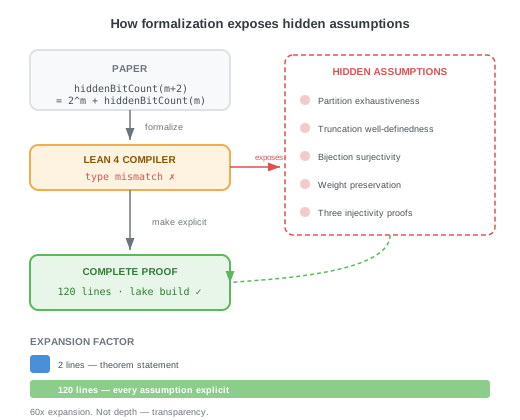
theorem hiddenBitCount_recurrence (m : Nat) :
    hiddenBitCount (m + 2) = 2 ^ m + hiddenBitCount m
Two lines. A recurrence relation on the count of words whose Fibonacci-weighted sum exceeds a threshold. Partition by one bit position, count each side. Any combinatorialist would call this straightforward.
The Lean 4 compiler disagreed. It demanded 120 lines of proof.1
Not because the mathematics was wrong. Because the mathematics was incomplete. The two-line statement silently assumed:
- That filtering by a single bit produces exactly two disjoint subsets that cover all cases (partition exhaustiveness)
- That removing the last two bits of a word preserves membership in the target set (truncation well-definedness)
- That appending bits constructs a valid inverse, with weight preservation across the bijection (surjectivity + weight accounting)
- That each of these bijections is injective, which requires case-splitting on three index ranges
Four hidden assumptions. Each one a place where a human reader fills in “obviously” and moves on. Each one a place where the compiler stops and says: prove it.
Act 1: The Compiler Won’t Read Your Mind
If you write software, you already know this feeling.
You migrate a JavaScript codebase to TypeScript. The code worked fine before. It ran, it passed tests, users were happy. Then the type checker lights up: undefined is not assignable to type string. Line after line. Not because the code was broken, but because it relied on assumptions that were never written down. That user.email is always a string. That the API response always has a data field. That the array is never empty.
TypeScript doesn’t add new logic to your program. It adds a requirement: say what you mean. Declare that email is string | undefined, handle the undefined case, and suddenly a class of runtime errors becomes impossible. The type system forces you to confront assumptions you were silently making.
Lean 4 does the same thing, but for mathematics.
Lean is a dependently typed programming language where types can express propositions and programs can serve as proofs. When you write theorem P : Prop, you are declaring a type. When you write a proof term, you are constructing a value of that type. If the proof compiles, it is correct. If it doesn’t, there is a gap.
The analogy is precise but not perfect. TypeScript’s structural type system catches one category of errors: data shape mismatches. Lean’s dependent type system is strictly more expressive: it can encode arbitrary logical propositions, quantified statements, and proof obligations. TypeScript tells you “this might be null.” Lean tells you “you haven’t proven that this set is finite” or “you assumed commutativity but didn’t establish it for this ring.”2
The gap between “TypeScript-level” and “Lean-level” checking is exactly the gap between catching bugs in software and catching gaps in mathematical reasoning.
Act 2: What Tao Sees
Terence Tao has spent the past several years formalizing mathematics in Lean and reflecting publicly on what the experience reveals. His observations, drawn from multiple interviews and writings between 2023 and 2026, converge on three points.
Transparency: assumptions become visible
When Tao’s collaborators formalized proofs using Lean, they discovered that the hardest parts were not the deep mathematical ideas. The hardest parts were the steps that mathematicians call “obvious.”
As described in a conversation with Math, Inc.: “researchers must confront the hidden assumptions and establish completely rigorous proofs.” The formalization process “reveals the precise inputs and outputs of every logical step.”3
This is not a statement about rigor for rigor’s sake. It is a statement about seeing. A formalized proof makes its dependency chain explicit. You can trace every conclusion back to its premises. You can ask: what does this theorem actually need to be true? And the answer is often surprising, because the informal version smuggled in assumptions that were never examined.
Engineering: mathematics becomes composable
Tao has noted that mathematics is moving toward something that resembles how modern industries work. As he told Scientific American: mathematics will “become much more like the way almost any other modern industry works.”4
The mechanism is the mathematical library. Lean’s community maintains mathlib, a repository of over 100,000 formalized definitions, lemmas, and theorems. When you formalize a new result, you build on mathlib the way a software engineer builds on npm or crates.io. The proof of your theorem declares its imports explicitly. If a dependency changes, the build system catches the inconsistency.
Tao observed that his own textbook’s informal approach already embodied this structure without knowing it. When formalizing Analysis I in Lean, he found that “the ‘naive type theory’ that I was implicitly using…dovetails well with the dependent type theory of Lean.” Quotient types, which his book uses to construct the integers from the naturals and the rationals from the integers, formalized “quite straightforward, with a pretty close match.”5
The implication: informal mathematics already has modular structure. Formalization makes that structure machine-checkable, composable, and reusable.
Division of labor: humans choose, machines verify
The third observation is about who does what. As of early 2026, Tao described current AI models as “useful assistants, but not peers: less helpful as sources of deep original ideas than as tireless systems for scanning known methods, connecting a problem to the right literature, and reporting back on what seems most promising.” The bottleneck, he argued, “shifts toward distinctly human capabilities: selecting worthwhile problems, designing sound workflows, and verifying results carefully.”6
Or, more bluntly: “AI will automate the boring, trivial stuff first. We will still be driving, at least for now.”7
Formalization is extremely tedious and time-consuming when done by hand.8 AI can handle the mechanical expansion. Humans focus on choosing which problems matter, deciding which structures to name, and judging which directions to pursue. The proof assistant ensures that no gap slips through.
Act 3: What Happens When You Take This to the Extreme
The Omega Project started with one equation, \(x^2 = x + 1\), and derived everything it could. Over ten thousand theorems. Tens of thousands of lines of Lean 4 code. And zero user-declared axioms.9
That last point needs precision, because it is easy to overstate. “Zero axioms” does not mean “no assumptions whatsoever.” Every Lean 4 proof rests on the system’s core logic: the Calculus of Inductive Constructions, universe polymorphism, and the axioms provided by Lean’s kernel (propositional extensionality, quotient types, choice). These are the “axioms of the compiler.” What “zero user-declared axioms” means is that the Omega codebase never invokes axiom to introduce an unproven assumption. Every theorem traces back to definitions, constructive arguments, and the standard library (mathlib). No shortcuts. No “assume P and derive Q.”
This is a direct consequence of formalization forcing hidden assumptions to the surface. If a proof needs an assumption, the compiler demands it. If the assumption is not provable from the definitions, it must be declared as an axiom. The Omega Project’s zero-axiom discipline is not a philosophical stance. It is what happens when you let the compiler be the arbiter: every assumption that can be derived is derived, and nothing is smuggled in.
The autoresearch test
The Omega Project recently built an autoresearch system that runs overnight batch formalization. An AI agent reads theorem statements from mathematical papers, generates Lean 4 proof attempts, and submits them to the compiler. If the proof compiles, it is committed to the repository. If it doesn’t, the error is logged and the agent tries again.
What’s interesting is what happens when the agent fails. Human mathematicians read a theorem statement and silently fill in context: which variables are bounded, which functions are continuous, which sets are finite. The AI agent does not have this implicit knowledge. When a proof attempt fails, the compiler error is almost always about a missing assumption that the paper took for granted.
Every hidden assumption becomes a compilation error. Every “obviously” becomes a type mismatch.
This is exactly what Tao described, running at scale. The autoresearch system does not have the human mathematician’s implicit context, so it exposes every gap. The compiler does not care about reputation or convention. It only asks: is this derivable from the definitions?
What the data shows
The hiddenBitCount_recurrence example from the opening is typical, not exceptional. Across the Omega codebase, the pattern repeats: theorem statements that fit in two to five lines routinely require proofs of fifty to a hundred lines. The expansion factor is not mathematical depth. It is the cost of making every assumption explicit.
Evidence
Lean: stableMul_inv_of_prime — “Every nonzero element of a prime-characteristic ring has an inverse.” Three-line statement, 38-line proof. The proof must broker between three representations (the combinatorial word type, ZMod p, and natural numbers), constructing explicit bridges that the informal statement treats as identity.
Evidence
Lean: hiddenBitCount_recurrence — “Partition by one bit, count each side.” Two-line statement, 120-line proof. Four hidden assumptions, two bijection constructions, three injectivity proofs.
So What
If you write code: you already understand this. The tool chain thinking you use every day — type checkers, linters, compilers that refuse to let you ship ambiguity — is the same thinking that is changing how mathematics gets done. The difference is not in kind. It is in what the types represent.
If you do mathematics: formalization is not a burden imposed on finished work. It is a lens that shows you the actual structure of your own proofs. The assumptions you find are not errors. They are the input specification of your theorem, written out for the first time.
The equation is \(x^2 = x + 1\). What it requires, precisely, is still being discovered.
Footnotes
hiddenBitCount_recurrence, Omega/Folding/MaxFiberTwoStep.lean, lines 73–194.↩︎For a precise comparison: TypeScript uses structural subtyping with union and intersection types. Lean 4 uses the Calculus of Inductive Constructions, where types depend on values, enabling propositions-as-types and proofs-as-programs. See the Lean 4 documentation.↩︎
A conversation with Terry Tao, Math, Inc. Note: some phrasings in the published conversation may reflect editorial summary rather than direct quotation.↩︎
AI Will Become Mathematicians’ ‘Co-Pilot’, Scientific American.↩︎
A Lean companion to “Analysis I”, Terence Tao’s blog, May 2025.↩︎
Terence Tao: AI is ready for primetime in math and theoretical physics, OpenAI Academy, March 2026. Paraphrase of reported positions.↩︎
Scientific American, ibid.↩︎
Is Math the Next AI Frontier? A Conversation with Terence Tao, Renaissance Philanthropy.↩︎
“Zero user-declared axioms” means the codebase contains no
axiomdeclarations. Lean 4’s core logic and the axioms in its kernel (propositional extensionality, Quot.sound, Classical.choice) are assumed by the system itself. See lean4/Omega/ for the full codebase.↩︎